30 markers at a board meeting? Yes — if you want to learn 3.5× faster (and remember more)

Lined and bulleted notes look “serious”, but very often they turn a person into a recorder, not a learner. If your goal is actual understanding and later recall, a more effective way is through mind maps + active recall + the Feynman technique. This combination not only structures the material, but also ruthlessly exposes gaps—exactly where the brain usually pretends it “already knows”.
Why Traditional Notes and Highlighters So Often Fail
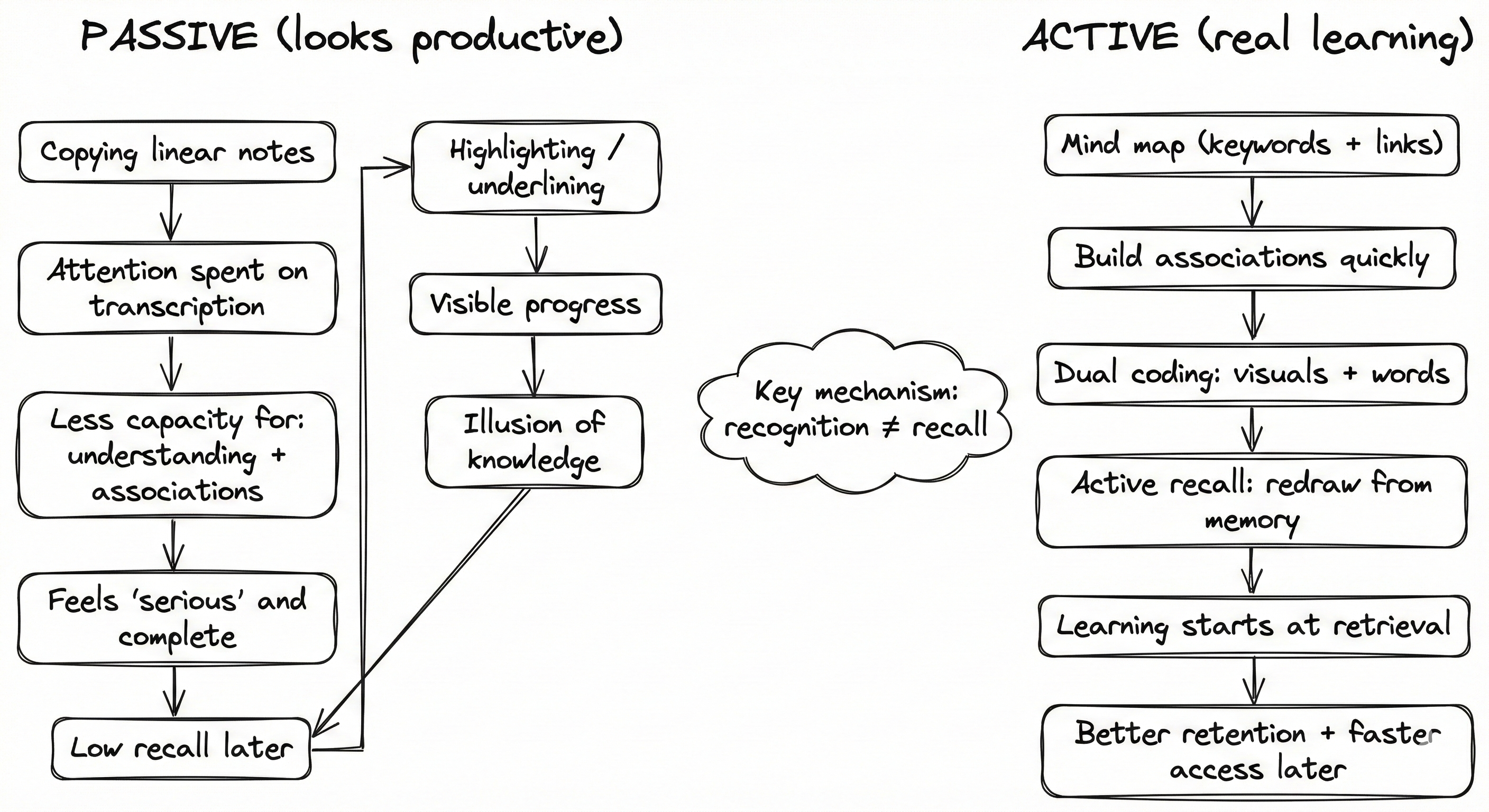
In school and university, it’s easy to fall into the mode: "just keep up and write down everything." The problem is simple: when all your attention goes into copying, there are no resources left for:
- understanding,
- building associations,
- connecting new information to what you already know.
Then comes highlighting. Colorful highlighters make you feel like you’re making progress (“look how many important things are marked!”), but studies have repeatedly shown this is usually an illusion of knowledge, not lasting learning.
You see a similar effect when reading ready-made, linear explanations (even well-formatted ones). You can try a simple test: read an answer on any topic, close your screen, and try to reproduce the main points. Without actively retrieving information from memory, surprisingly little remains.
The key mechanism is this: real learning begins when you have to recall something, not when something simply “looks nice” in your notes.
The Two Real Functions of Notes (and How Mind Maps Deliver Both)
Notes make sense if they do two things:
- Help connect and understand material "here and now" (e.g., during a lecture).
- Let you quickly recall the material later—when you return after weeks or months.
Mind maps work in both modes, but their biggest advantage appears in the latter. When the topic resurfaces (an exam, project, or client), what matters isn’t how many pages you’ve written, but whether you are able to quickly dive into the structure of knowledge.
"Radiant Thinking": Mind Maps Mirror How the Brain Is Organized
A mind map starts from the center and branches out—like a sun drawing with rays. This shape resonates well with how neurons look: a core and branches (dendrites). This isn't just a metaphor for “a nice story”, but rather a practical argument: such an arrangement supports what is most important in learning—associations.
In linear notes, finding a connection between “point 1” and “point 50” means flipping through half the material. In a mind map, often one line—even an ugly one—is enough to connect two concepts and immediately see the relationship.
Dual Coding: Why Pictures + Words Beat Text Alone
Mind maps engage at least two channels for encoding information:
- Visual (drawing, layout, symbols, color),
- Verbal (keywords).
This is the classic effect known as dual coding: material is encoded in parallel in different areas, which strengthens memory traces and eases recall.
In practice, it’s even better to add more associations (even “silly” ones): drawings, absurd scenes, sounds, smells. The principle is brutally simple: the more meaningful associations, the more anchors for memory.
A key clarification: many mind map apps stop at linking colorful words. That’s not enough. A mind map works best when it includes creativity, symbols, and your own associations—even doodles. Those are what really stick in memory.
What the Numbers Say: +7.229% Knowledge, +10% Skills, and 3.5× Faster Access to Information
In a meta-analysis comparing classical notes versus mind mapping among nurses, the results are clear:
- +7.229% on pure knowledge tests,
- almost +10% on practical skills tests.
That’s a difference that, in real life, separates “passed” from “definitely passed”.
But even more interesting is what happens later. Over time, when participants returned to the material and used their notes, those working with mind maps were able to find the information they sought 3.5× more efficiently. So you don’t just remember more—you find it faster.
This advantage explains why mind maps are an investment: creating them takes more effort up front, but the payoff comes when you revisit the subject.
Real Life Story: 15-Minute Break and an "A" on Weeks of Material
At XIV LO (High School No. 14), which for years was considered one of the best in Poland, there was a classic pressure for a “pretty notebook.” Despite this, it was possible throughout high school to take notes in mind maps—sometimes with teacher’s remarks in the background.
In a critical moment before an unannounced quiz, all it took was 15 minutes during break to review your own mind map and recall the details (including bits from the assigned reading). Result: full answers to questions and the highest grade.
There’s one condition you cannot skip: the map has to be your own (or at least “walked through” and explored by you). A ready-made map does not create the same connections.
Why Mind Maps Can Be Uncomfortable (And Why That's a Great Sign)
Creating a mind map is not about copying. It’s about:
- choosing keywords,
- deciding what’s primary and what’s secondary,
- building connections.
It takes cognitive effort—often with clear discomfort. And that’s the point: the power of associations grows proportionally to the effort you put into building them.
If you think “this is exhausting”—it’s a sign your brain is genuinely working, not just “scrolling through content with your eyes”.
Keywords Instead of Sentences: This Is Where Real Learning Happens
The skill isn’t to write down a sentence from a lecture. The skill is to distill it into 1–3 words that carry the meaning.
This “compression” does three things at once:
- forces you to understand,
- personalizes the material (your associations are different from others’),
- creates natural memory hooks.
A good keyword doesn’t even have to appear in the source. It should work as a mental shortcut that, after a while, triggers an entire branch of knowledge.
Miller's Law and the Branch Limit: 5–7 Is the Golden Range
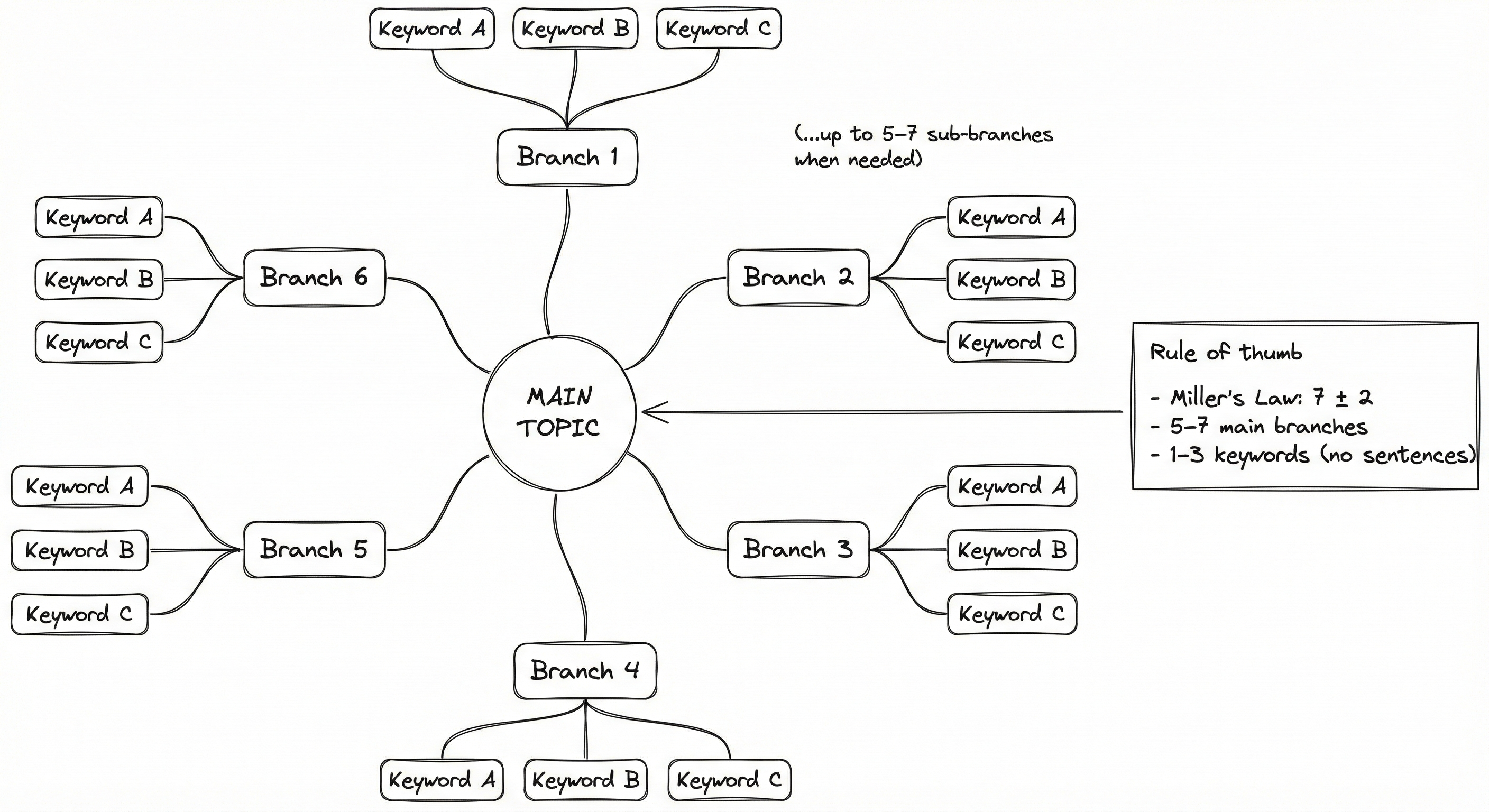
With mind maps, it's easy to go overboard and create a monster even the author gets lost in. A well-known constraint of working memory helps: Miller’s law—7 ± 2 elements in a sequence.
So the practical rule for building a map is:
- 5–7 main branches from the center,
- In each branch, 5–7 sub-branches (if possible),
- short labels, not paragraphs.
It’s the same reason phone numbers have a sensible length, and ID numbers are mentally split into chunks.
Case Study: Book on Respirators—40 Chapters Compressed Onto 2 A4 Sheets
For heavy materials full of data and repetition, mind maps make a spectacular difference.
In a practical medical example, it was necessary to absorb a book on respirators: lots of information on lungs, systems, definitions—and just a week to take it in. Passive reading didn’t work, and copying notes was pointless (the notes were no different from the book).
Switching to mind maps revealed that:
- The content of 40 chapters repeated the same definitions and relationships,
- Everything could be condensed to two A4 sheets,
- One day of work was enough, and then those notes continued to serve (e.g., for a PhD).
This shows one more thing: books are only “linear” in the order of pages. Conceptually, they are a web of connections—which is exactly what a mind map naturally reveals.
Feynman + Active Recall + Mind Map: A Protocol That Acts As a Mirror for Your Knowledge
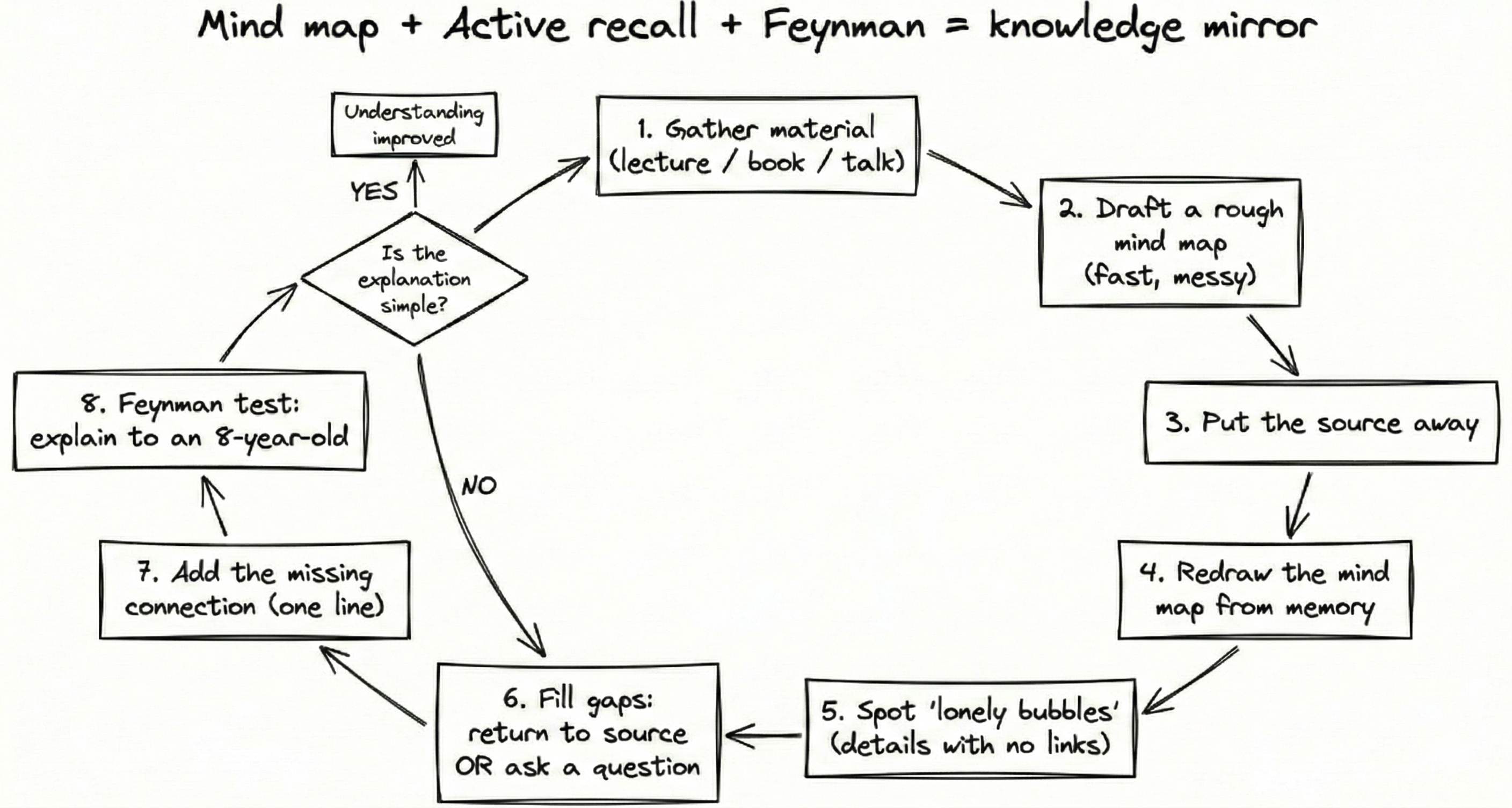
Richard Feynman is known not just as a great physicist but as a symbol of this approach: if you can’t explain something simply, you don’t really understand it yet. In practice, the “Feynman technique” often boils down to this test: explain a concept as if to an eight-year-old.
This combines beautifully with active recall and mind maps into one simple process:
- Gather material (lecture, TED Talk, book) and make a rough mind map—quickly, even with doodles.
- Put away the source.
- Create the map again purely from memory: what do you remember? what is the center? what are the branches?
- Where “lonely clouds” appear (you remember a detail but not how it connects)—that’s a clear sign of a gap.
- Only then do you fill in the gaps: go back to the source, or ask (for example, ChatGPT: “how does X connect with Y?”) and draw in the missing connection.
This is active recall in action: you’re not checking if you “recognize the content”, but if you can reproduce and connect it.
It’s worth mentioning Scott Young here, the creator of “Ultralearning”. He became famous for undertaking the challenge of mastering the MIT curriculum on his own: in about a year, he covered a program that normally takes several years, and passed the exams—proving you can learn effectively “for zero dollars”. This is an extreme case, but it illustrates the power of methodical active recall and working toward understanding instead of copying.
Why Adults Are Embarrassed by Mind Maps (and How to Overcome That at Work)
Mind maps have another barrier: a social one.
In a boardroom, in suits, when someone takes out 30 markers and starts coloring on white paper, it’s easy to get labeled as “unprofessional”. The same thing can happen on public transport—coloring notes draws attention and can be seen as “weird”.
This is one reason why a proven technique hasn’t become the standard. The fix can be simple: change the context so that using a mind map feels “normal”.
One organizational example that works instantly: in the meeting room, white paper and markers are already waiting in cups. No one has to “bring their own”. The threshold for embarrassment disappears, acceptance grows, and note-taking actually boosts thinking.
Mind Maps and Interdisciplinarity: The World Isn’t Divided Into Subjects
The division into physics, chemistry, and math is logistical. The brain works differently: it looks for overlaps.
A classic school absurdity: in physics, you encounter a quadratic function, but no one calls it that. In math, the topic shows up half a year later. Understanding “escapes between silos”.
Similarly, with links between music and math—it’s often only after the fact that you see how one field supports another. A mind map is a tool you don’t get from just a collection of separate notebooks: you can connect concepts with a line, even if “formally” they come from different drawers.
This logic goes far beyond school—even in discussions about how interdisciplinary the world has become (including Nobel Prize categories and the lack of a Nobel in mathematics). Discoveries more and more often don’t fit into simple boxes.
Why Schools Rarely Teach This: Program Pressure and Cheap Assessment
There are several barriers, and it’s not just about “bad teachers”:
- The core curriculum dictates pace and content,
- There’s a lack of systematic teacher training in learning techniques,
- Linear forms of assessment dominate, because they are logistically cheap (tests, answer keys, quick grading).
Yet sometimes all it would take is giving students 10 minutes to draft a mind map before having them write an essay or a paper. With a map, it’s easier to keep your thread and not lose your train of thought halfway.
Conclusions (Specifically)
- Highlighters and copying often create an illusion of progress, not real memory.
- Mind maps support both purposes of notes: understanding now and recalling later.
- Dual coding (image + word) boosts memory; your own doodles and associations work better than sterile diagrams.
- Studies among nurses showed +7.229% on knowledge tests, ~+10% on practical skills, and 3.5× more effective access to information after time.
- The greatest value comes from combining: mind map + active recall + Feynman technique.
- The social “marker embarrassment” is a real barrier—but it can be overcome by changing norms in your team and environment.
How to Implement This Immediately: A Simple 7-Day Plan
Day 1: Prep Your Tools - Sheets of paper A4 or larger, preferably white (no grids or lines). - 4–8 markers in different colors.
Day 2: Make Your First Map From a Short Piece of Material - Take a 10–15 minute piece (e.g., a dense TED Talk). - In the center, write the title/thesis + author. - Create 5–7 main branches.
Day 3: Practice Keywords - Describe each branch in 1–3 words, no full sentences. - Add 2–3 sub-branches for examples, definitions, or “memory hooks”.
Day 4: Active Recall — Map From Memory - Put away the source material. - Draw the map again from your head. - Mark places where “lonely clouds” appear (you know something exists but don’t remember how it connects).
Day 5: Fill in the Gaps Precisely - Go back to the source only to fill in missing connections. - If needed, ask (e.g., ChatGPT: “How does X connect to Y?”) and draw one line to close the gap.
Day 6: The Feynman Test - Take one branch and explain it in 2–3 sentences “for an eight-year-old”. - If you can’t do it simply—return to the map and refine your keywords.
Day 7: Apply It to a Real Task - Plan a text/report/presentation: 10 minutes with a mind map as an outline. - Only afterwards start writing or making slides.
If after a week only one habit sticks, let it be this: after studying, always recreate the map from memory. That’s the quickest way to separate “I read” from “I understand”.